 pin 5 (normally green cable)
NMEA0183 is an international standard for data exchange between navigational devices. It describes the underlying hardware as well as the format of messages that may be exchanged.
On the hardware side, NMEA0183 defines RS422 as the standard that shall be used to connect devices. RS422 is a robust serial interface based on balanced lines, i.e. the signal is transported via two separate cables with an extra ground line.
The unloaded signal level of RS422 is +/-6V
The maximum cable length is specified as 1200m
Although NMEA0183 specifies RS422 as its communication standard, most manufacturers of navigational devices especially for the yachting market build their devices compatible for the RS232 interface which is part of any IBM compatible PC nowadays.
The unloaded signal level of RS232 is +/-25V (max.)
The max. cable length is about 15m, but since the bitrate specified with NMEA0183 (4800bps) is rather slow and the amount of noise signals on yachts is usually not very high, you should be able to connect devices over distances up to 30m without problems in practice.
Thus RS232 will be usually all, what you need aboard a yacht to connect to your NMEA0183 capable devices. If you need longer cables than about 30m, you will have to buy one of the numerous RS422 interface cards or adapters for your PC. Please contact FstSoft for advice where to get an appropriate device.
Caution: Although NMEA0183 specifies a fixed baudrate of 4800baud, some GPS devices have configurable baudrates. Currently NautLog doesn't support this, thus you have to configure your device to 4800 baud.
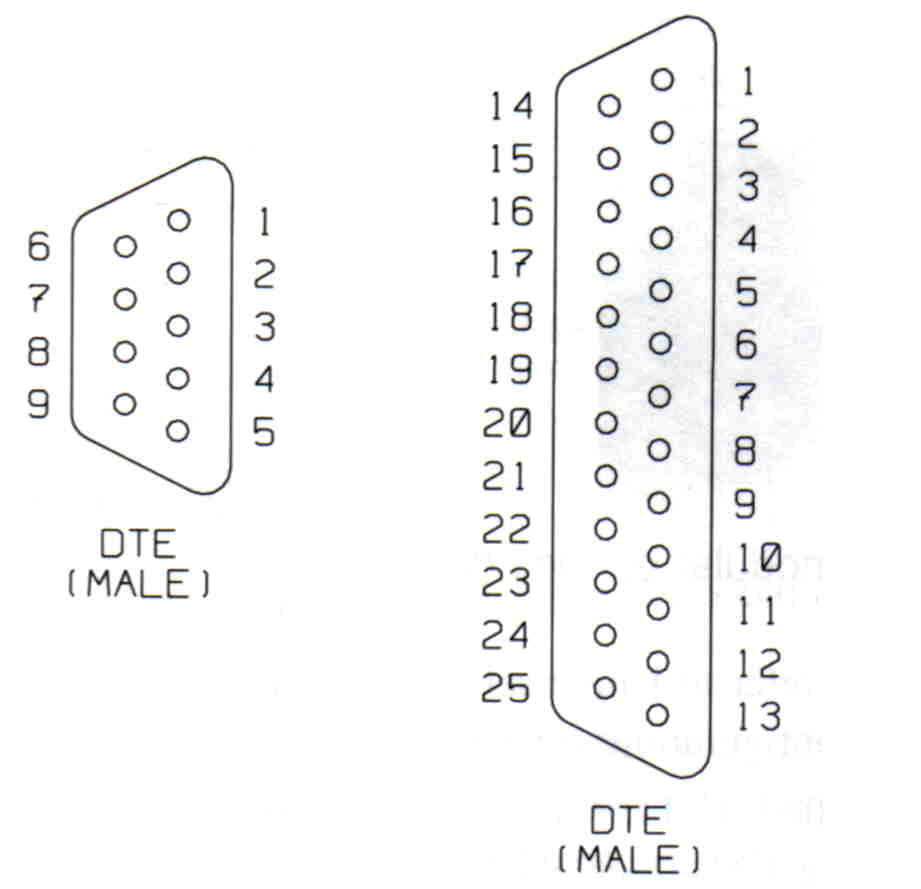
RS232 will normally be connected with a 9 pin D-SUB plug (male). The protocol in NMEA0183 is very simple: Your PC is just listening all the time to the signals coming in and will look for NMEA sentences, which always start with the a '$' character. There is no handshake at all, thus there are only two lines necessary:
Ground and signal.
You can take any standard serial cable either with 9 pin D-SUB or with 25 pin D-SUB, whatever matches to your PC (will be nearly always 9 pin nowadays). Follow the instructions in the manual for your navigational device to connect the device's signal output as follows
device - signal ground pin 5 (normally green cable)
devive - signal
pin 2 (RXD, normally red cable)
device - signal ground pin 7
devive - signal
pin 3 (RXD)
Here the pin-layout oof the 9 and 25pin D-SUB plugs:
If you want to learn more about the NMEA0183 standard you may look at NMEA (National Marine Electronics Association) 0183 Standard